Manganese Dioxide for Bricks, Tiles and Ceramics: Dosage, Colours and Firing
How manganese dioxide colours bricks, tiles, terracotta and glazes: the colours it gives, typical dosage ranges, how to mix it, what happens in the kiln, and how to adjust the dose between grades.
By Akshay Dangar, BDE · · 5 min read
On this page
Manganese dioxide (MnO₂) is one of the oldest and cheapest ways to colour fired clay. Added to a brick or tile body, it turns the usual red or buff into browns, chocolate shades, grey-browns and near-black. In glazes it gives browns, purples and metallic effects. Most brick and tile makers use it as a natural manganese ore powder rather than a refined chemical, because the ore colours just as well at a fraction of the cost.
This guide explains what manganese dioxide does in clay and glazes, typical dosage ranges, how to mix it, what happens in the kiln, and how to adjust your dose if you change grade. It is based on the natural manganese dioxide powder we supply.
Our manganese dioxide for ceramics
| Property | Value |
|---|---|
| Product | Manganese dioxide 55% (natural manganese ore powder) |
| MnO₂ | 54 – 56% (recent lot: 55.73%) |
| Total manganese (Mn) | Recent lot: 36.59% |
| Iron (Fe) | Below 15% (recent lot: 10.62%) |
| Fineness | 200 mesh (recent lot: 89.56% passing) |
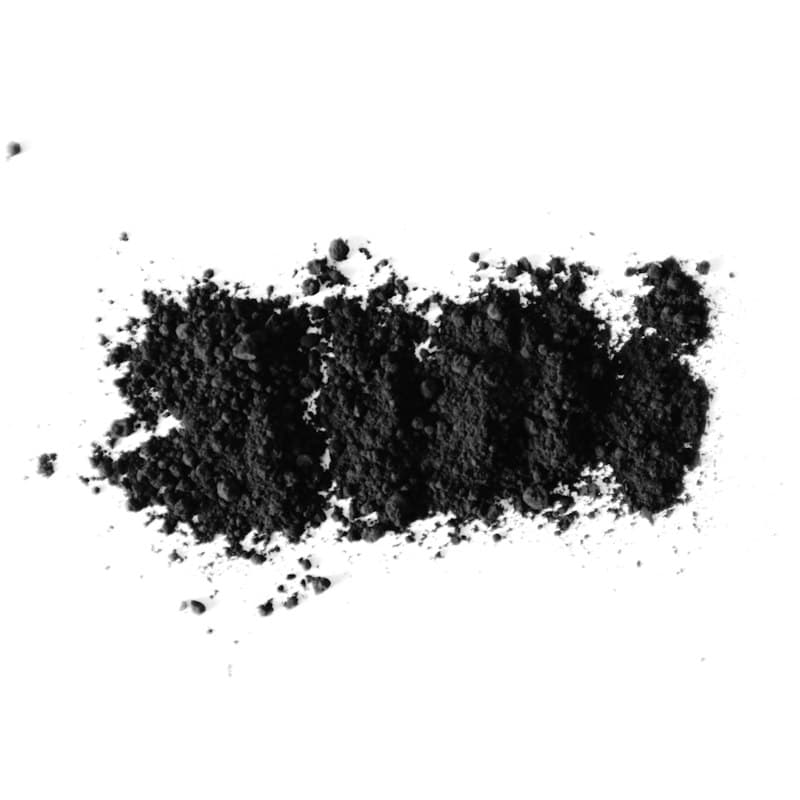
| Appearance | Black fine powder |
| Packing | 50 kg HDPE bags, about 27 tonnes per 20 ft container |
For the full COA results and what each figure means, see Manganese dioxide 55%: specifications, COA results and uses.
The iron in natural ore is not a problem in bricks and tiles. It adds to the colour, giving warmer brown tones.
What manganese dioxide does in clay
During firing, manganese dioxide breaks down into lower manganese oxides that react with the clay. These oxides are strongly coloured and spread through the body, so even a few per cent changes the fired colour completely. Together with the iron already in most brick clays, manganese produces the browns and dark tones that are hard to get any other way at low cost.
| Product | What manganese dioxide gives |
|---|---|
| Facing bricks and pavers | Brown, chocolate, grey-brown and dark "smoked" colours, and darker blends |
| Roof tiles and terracotta | Rich browns and antique, darker shades |
| Floor and wall tiles (body or engobe) | Brown and dark body colours |
| Pottery glazes | Browns; purple and violet in alkaline glazes; metallic brown-black at high amounts |
| Slips and engobes | Brown to black decorative coatings |
Typical dosage ranges
How much you need depends on your clay, your firing temperature and atmosphere, and the colour you want. These are typical starting points for trials, by weight of dry clay or dry glaze:
| Use | Typical starting range (55% MnO₂ powder) | Typical result |
|---|---|---|
| Bricks, light brown tint | 1 – 2% | Warmer, browner version of the clay's own colour |
| Bricks, brown to chocolate | 2 – 5% | Even brown to dark brown |
| Bricks, dark grey-brown to near-black | 5 – 8% | Dark tones, especially with iron-rich clay |
| Roof tiles and terracotta | 2 – 6% | Browns and antique shades |
| Glazes | 2 – 8% of the dry glaze | Browns; purple in alkaline glazes; metallic at the top of the range |
| Slips and engobes | 5 – 15% | Strong brown to black coatings |
Always confirm your dose with test firings (see below). Going far beyond what you need doesn't help: extra manganese can cause surface defects without making the colour much darker.
Mixing it into the clay
- Dry-blend first. Mix the powder with the dry clay, or with a portion of it, before water goes in. This spreads it far more evenly than adding it at the end.
- Weigh every batch. Colour follows the dose closely, so weighing rather than scooping keeps one batch matching the next.
- Or add it as a slurry. In wet or slurry processes, disperse the powder in water first and meter the slurry in.
- Mix thoroughly before pugging or extrusion. Uneven mixing shows up as streaks and patches after firing.
- Use the right fineness. Our 200-mesh powder gives an even, all-over colour. Coarse, granular manganese is used instead when makers want dark speckles; tell us if you need a coarser grind.
What happens in the kiln
It releases oxygen as it heats
Manganese dioxide gives off oxygen in stages as it is heated: first at around 500–550 °C, then again near 1,000 °C, as it changes to lower oxides. In most brick and tile bodies this escapes harmlessly. But in dense bodies, thick glazes or fast firing, the gas can be trapped and cause bloating, pinholes or blisters. If you see these:
- slow the firing through the temperature ranges above
- reduce the dose
- make sure the glaze or surface is still open while the gas escapes
Temperature and atmosphere change the colour
- Higher temperatures usually give darker, deeper colours, because the manganese reacts further with the clay.
- Oxidising firing (plenty of air) gives clearer browns.
- Reduction firing (limited air) gives darker, greyer and near-black tones.
Because of this, the same dose can look different from one kiln, or one part of a kiln, to another. Test in your own kiln, at your normal firing curve.
Manganese acts as a flux
At high temperatures manganese oxides help the clay melt slightly. At high doses this can increase shrinkage and lower the temperature at which bricks start to deform. Check dimensions and strength when you first raise the dose.
Test before you change your process
Before a full production run:
- Make test pieces from your normal clay with several doses, for example 0%, 1%, 2%, 4% and 6%.
- Fire them together in your normal kiln, at your normal temperature and firing curve.
- Compare colour, surface and size, and check for bloating or blistering.
- Pick the lowest dose that gives the colour you want. It is the cheapest, and the least likely to cause defects.
Changing grade? Adjust the dose
The colouring power of manganese ore follows its manganese content. If you switch grade, adjust the dose in proportion:
new dose = old dose × (old MnO₂ % ÷ new MnO₂ %)
For example, if you used 3% of a 70% grade, start at about 3 × 70 ÷ 55 ≈ 3.8% of our 55% grade, then confirm with a test firing. The 55% grade is usually the more cost-effective choice, because its lower price per kilogram more than makes up for the slightly higher dose.
Safety
- Control the dust. Manganese dust is harmful if breathed in, and long-term exposure can affect the nervous system. Use dust masks (P2 / N95 or better) and dust extraction where bags are tipped and clay is mixed.
- Ventilate the kiln area. Firing releases manganese-containing fumes, especially at high doses and with glazes. Make sure kiln gases are vented outside.
- Wear gloves and safety goggles when handling the powder.
- Store bags dry and off the floor, and keep them closed.
The full safety data sheet comes with every order. See our guide to what to check in an SDS.
Request a quote
To get a price for manganese dioxide for your brick, tile or pottery plant, send us:
- Monthly or one-time quantity
- What you make, for example facing bricks, roof tiles or glazes, and the colour you're aiming for
- Fineness: 200 mesh as standard, or coarser for speckles
- Delivery location, or your destination port
See the Manganese Dioxide product page for packing and minimum order, or contact us for a quote.
Frequently asked questions
How much manganese dioxide is used to colour bricks?
Typically 1–8% of the dry clay weight with a 55% MnO₂ powder: around 1–2% for a light brown tint, 2–5% for brown to chocolate and 5–8% for dark grey-brown to near-black. Confirm the dose with test firings in your own kiln.
What colours does manganese dioxide give in ceramics?
In clay bodies it gives browns, chocolate, grey-brown and near-black shades, darker with more iron, higher temperature or reduction firing. In glazes it gives browns, purples in alkaline glazes and metallic effects at high amounts.
Why do my bricks or glazes blister after adding manganese dioxide?
Manganese dioxide releases oxygen as it heats, at around 500–550 °C and again near 1,000 °C. In dense bodies, thick glazes or fast firing the gas can be trapped. Slow the firing through those ranges or reduce the dose.
Is natural manganese ore powder suitable for bricks and tiles?
Yes. Natural ore at around 55% MnO₂ colours bricks, tiles and terracotta as well as refined grades at a much lower cost, and its iron content adds to the warm brown tones.
How do I change the dose if I switch to a different MnO₂ grade?
Adjust in proportion to the MnO₂ content: new dose = old dose × old MnO₂ % ÷ new MnO₂ %. For example, 3% of a 70% grade becomes about 3.8% of a 55% grade. Confirm with a test firing.
What mesh size is best for colouring bricks?
200 mesh gives an even, all-over colour and is our standard grade. Coarser granular manganese is used to create dark speckles; tell us if you need a coarser grind.
- #manganese dioxide for bricks
- #brick colouring
- #ceramic colourant
- #MnO2 in glazes
- #manganese ore powder
- #terracotta
- #roof tiles
- #pigment