How to Dilute and Store Sulphuric Acid Safely: Dilution Chart, Density and Tank Materials
A practical guide to diluting 98% sulphuric acid to 70%, 50%, battery strength or 10%: the acid-into-water rule, a dilution chart, density by strength, and which tank materials to use.
By Bharti Gohel · · 5 min read
On this page
Most industrial sulphuric acid is shipped at 98%, the strongest ordinary grade. It is the cheapest way to move the acid, because you pay to ship H₂SO₄ rather than water. But many processes run on weaker acid: 70% for fertilizers, around 37% for batteries, 10–25% for metal pickling and pH control. So buyers dilute on site.
Diluting and storing sulphuric acid is simple if you follow a few rules, and dangerous if you don't. This guide gives a dilution chart for 98% acid, the density of each strength, the right tank materials, and the mistakes to avoid. The figures are based on the sulphuric acid 98% we supply.
Our sulphuric acid 98% at a glance
| Property | Value |
|---|---|
| Purity | Min. 98.0% (recent lot: 98.0%+) |
| Specific gravity at 20 °C | 1.82 – 1.84 (recent lot: 1.83) |
| Iron (as Fe) | Max. 20 ppm (recent lot: 12 ppm) |
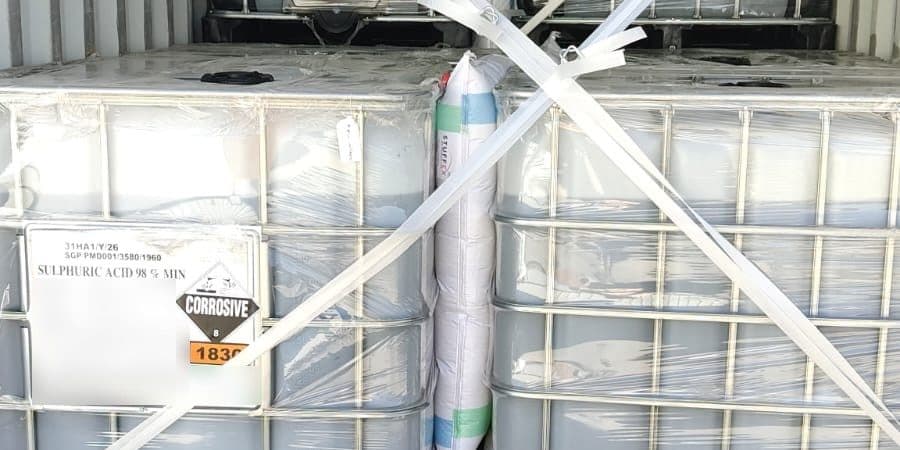
| Packing | 1,650 kg IBCs (about 900 litres), drums or tankers |
| UN number | UN 1830, Class 8 (corrosive), Packing Group II |
For the full COA results and supply details, see Sulphuric acid 98%: specifications, COA results and supply near Mundra Port.
The golden rule: always add acid to water
Always add the acid slowly to the water, never water to the acid.
Mixing sulphuric acid with water releases a lot of heat. If you pour water into concentrated acid, the first water to arrive boils on contact and throws out hot acid. If you add acid to a larger amount of water, the water absorbs the heat safely.
In practice:
- Put the full amount of water in the tank first, using cold water.
- Add the acid slowly in a thin stream, with continuous stirring or circulation.
- Watch the temperature. Pause, or cool the tank, if it gets hot. Large batches need a cooling coil or jacket.
- Let the solution cool before closing the tank or using it.
Dilution chart: making weaker acid from 98%
To make 100 kg of diluted acid from 98% sulphuric acid:
| Target strength | 98% acid (kg) | 98% acid (litres) | Water (kg or litres) |
|---|---|---|---|
| 93% | 94.9 kg | 51.7 L | 5.1 |
| 70% | 71.4 kg | 38.9 L | 28.6 |
| 50% | 51.0 kg | 27.8 L | 49.0 |
| 37% (battery strength) | 37.8 kg | 20.6 L | 62.2 |
| 25% | 25.5 kg | 13.9 L | 74.5 |
| 10% | 10.2 kg | 5.6 L | 89.8 |
The litres of acid are based on a density of 1.836 kg/L for 98% acid. For any other strength:
kg of 98% acid = (target % ÷ 98) × kg of solution you want, and the rest is water.
Always weigh where you can. Measuring by volume is less accurate, because the solution shrinks a little as the acid and water mix.
Density by strength
Density, or specific gravity, is the quickest check on a diluted batch. Standard values at 20 °C:
| H₂SO₄ strength | Specific gravity (kg/L) | Litres per tonne |
|---|---|---|
| 98% | 1.836 | 545 |
| 96% | 1.835 | 545 |
| 90% | 1.814 | 551 |
| 80% | 1.727 | 579 |
| 70% | 1.611 | 621 |
| 60% | 1.498 | 668 |
| 50% | 1.395 | 717 |
| 40% | 1.303 | 767 |
| 35% | 1.260 | 794 |
| 20% | 1.139 | 878 |
| 10% | 1.066 | 938 |
Why density alone can't confirm 98%
Density is useful for dilute acid, but not for telling 93% from 98%. The density of sulphuric acid peaks at around 97–98% and hardly changes between 93% and 99%. A specific gravity of 1.83 fits our 98% acid, and it would also fit 93% acid. That is why the purity on a COA is measured by titration, not by density. Check the purity figure on the COA, not just the specific gravity.
Which strength is used for what?
| Strength | Common uses |
|---|---|
| 98% | Chemical manufacturing, alum and sulphate salts, fertilizers, drying gases |
| 93% (66 °Bé) | Fertilizers and chemicals; stays liquid in cold weather |
| 70 – 80% | Single superphosphate (SSP) fertilizer production |
| 50% | pH control, chemical processing |
| 35 – 40% | Lead-acid battery electrolyte (battery grade) |
| 10 – 25% | Steel pickling, pH adjustment, cleaning |
Storage: choosing the right tank material
Concentrated and dilute sulphuric acid behave very differently, so the tank material has to match the strength:
| Strength | Suitable | Avoid |
|---|---|---|
| 93 – 99% | Carbon steel tanks (the standard for bulk storage), stainless steel; HDPE IBCs and drums for transport at ambient temperature | Letting water or moist air in: diluted acid attacks steel |
| 80 – 93% | Stainless steel, lined steel; ask for a material check | Plain carbon steel at higher temperatures |
| Below about 80% | HDPE, polypropylene, FRP (vinyl ester), PVDF, rubber-lined or PTFE-lined steel | Carbon steel, which corrodes quickly at these strengths |
Strong acid forms a protective iron sulphate layer on carbon steel, which is why steel tanks work for 98% acid. Once the acid is diluted, that layer dissolves and the steel corrodes fast, giving off flammable hydrogen gas. So:
- Never store diluted acid in a tank built for 98%.
- Keep concentrated-acid tanks dry. Fit a desiccant breather on the vent so moist air can't dilute the acid at the surface.
- Vent steel tanks and keep sparks and flames away, because of the hydrogen risk.
- Give every tank secondary containment (a bund) that holds at least the full tank volume, lined with acid-resistant material.
- Label tanks and pipes with the strength and the corrosive hazard sign.
Watch out for freezing in cold climates
Sulphuric acid 98% freezes at only a few degrees above 0 °C, so tanks and pipelines exposed to winter weather can freeze. Acid at 93% (66 °Bé) stays liquid down to well below −30 °C, which is why it is preferred in cold regions. If you store 98% acid outdoors in winter, insulate or heat-trace the tanks and lines, or plan to dilute to 93% on arrival.
Battery acid is a different grade
Battery electrolyte is diluted to about 35–38% (specific gravity around 1.26–1.28) with demineralised water. It must be made from battery-grade acid, with tighter limits on iron and other metals than industrial acid. Our industrial grade is not sold as battery acid. Tell us your specification and we will confirm availability.
Safety essentials
- Wear protective equipment when diluting: chemical goggles with a face shield, acid-resistant (neoprene) gloves, an acid-resistant apron and boots.
- Keep a safety shower and eyewash station next to the dilution area.
- Skin or eye contact: flush with running water for at least 20 minutes and get medical help immediately.
- Spills: contain with dry sand or earth, not water, then neutralise the residue with soda ash or lime.
The full safety data sheet comes with every order. Read our guide to what to check in an SDS.
Request a quote
We supply sulphuric acid 98% in 1,650 kg IBCs, drums or tankers, with a COA for every lot. To get a price, send us:
- Quantity, and whether it is a one-time or a regular requirement
- Packing: tanker, IBCs, drums or carboys
- Delivery location, or your destination port
- The strength you use on site, if you'd like advice on dilution or storage
See the Sulphuric Acid product page or contact us for a quote.
Frequently asked questions
How do you dilute sulphuric acid safely?
Always add the acid slowly to the water, never water to the acid. Put the full amount of cold water in the tank first, add the acid in a thin stream while stirring, watch the temperature and let the solution cool before use.
How much 98% sulphuric acid and water make 50% acid?
For 100 kg of 50% acid, use 51.0 kg of 98% acid (about 27.8 litres) and 49.0 kg of water. Add the acid to the water, never the other way round.
What is the density of 98% sulphuric acid?
About 1.836 kg per litre at 20 °C, so one tonne is about 545 litres. Our recent lot tested at a specific gravity of 1.83, within its 1.82–1.84 specification.
Can I store sulphuric acid in a carbon steel tank?
Yes for 93–99% acid: carbon steel is the standard for bulk concentrated acid. No for acid below about 80%: dilute acid corrodes carbon steel quickly and gives off hydrogen. Use HDPE, polypropylene, FRP or lined steel instead.
Does sulphuric acid freeze?
98% acid freezes at only a few degrees above 0 °C, so outdoor tanks and lines need insulation or heating in cold climates. 93% acid stays liquid down to well below −30 °C.
Can I make battery acid from industrial sulphuric acid?
Battery acid is diluted to about 35–38% with demineralised water and needs battery-grade acid with tighter limits on iron and other metals. Tell us your specification and we will confirm availability.
- #sulphuric acid dilution
- #sulfuric acid
- #dilution chart
- #sulphuric acid density
- #sulphuric acid storage tank
- #battery acid
- #H2SO4 98%