Importing Industrial Chemicals into Canada: WHMIS, SDS, Customs and Documents
A practical checklist for Canadian buyers of industrial chemicals: WHMIS 2015 labels and bilingual SDS, CBSA customs and CARM, dangerous-goods transport, substance-list and precursor checks, and the documents to ask your supplier for.
By Kant Exim team · · 6 min read
On this page
Buying industrial chemicals from overseas can cut costs considerably, but a shipment that arrives without the right labels, safety data sheets or customs paperwork can sit at the port while storage charges add up.
This guide covers what a Canadian importer needs to get right, from WHMIS 2015 to CBSA customs, so the first order clears smoothly. It is written for buyers of industrial, water-treatment and agricultural chemicals such as sulphuric (sulfuric) acid, caustic soda, PAC, alum and fertilizer salts.
This is general guidance, not legal advice. Rules change and depend on the product and quantity — always confirm the details for your shipment with your customs broker.
The checklist at a glance
| Area | What to check | Who regulates it |
|---|---|---|
| Hazard communication | WHMIS 2015 supplier label and SDS, in English and French | Health Canada |
| New substances | The chemical is on the Domestic Substances List (DSL) | Environment and Climate Change Canada / Health Canada |
| Precursor chemicals | Whether the product is a listed precursor, and whether registration or permits apply | Health Canada |
| Customs | Business Number, CARM registration, tariff classification, duties and GST | Canada Border Services Agency (CBSA) |
| Transport | TDG rules for dangerous goods moved within Canada | Transport Canada |
| Food and fertilizers | Safe Food for Canadians licence; fertilizer registration or exemption | Canadian Food Inspection Agency (CFIA) |
1. WHMIS 2015: labels and safety data sheets
Canada's hazard-communication system is WHMIS 2015, set out in the Hazardous Products Act and Hazardous Products Regulations. It is aligned with the Globally Harmonized System (GHS), so a good GHS safety data sheet is the right starting point — but Canada adds its own requirements.
- A hazardous product sold or imported for use in a Canadian workplace needs a WHMIS-compliant supplier label and safety data sheet (SDS).
- Both must be available in English and French.
- The SDS follows the standard 16-section format, from identification and hazards through to transport and regulatory information.
- As the importer, you are responsible for making sure a compliant label and SDS are in place — as the supplier if you resell the product, or as the employer if you use it in your own workplace.
What to do: ask your overseas supplier for the SDS before you place the order, not with the shipment. Your WHMIS consultant or broker can then confirm whether it needs adapting for Canada, and have the French version and Canadian labels prepared in time. See our guide to what to check in an SDS.
2. Is the substance allowed? DSL and precursor checks
Domestic Substances List
Under the Canadian Environmental Protection Act, 1999, a chemical substance that is not on the Domestic Substances List (DSL) is treated as "new" and must be notified before it is imported above certain quantities. Common industrial chemicals — sulphuric acid, caustic soda, soda ash, alum and most fertilizer salts — are long-established and listed, but check the CAS number of anything unusual, especially blends and specialty products.
Precursor chemicals
Some everyday industrial chemicals are also listed precursors in Canada, because they could be diverted to make illegal drugs. Sulphuric acid, hydrochloric acid, acetone and toluene appear on Schedule VI of the Controlled Drugs and Substances Act. Depending on the class of precursor and the quantity, registration, permits or record-keeping may apply to importers. Ask your broker to confirm this for your product before the first order.
3. Customs: CBSA, CARM, tariff classification and duties
Get set up before the shipment leaves
- Business Number with an import–export (RM) program account from the Canada Revenue Agency.
- CARM registration. CBSA's Assessment and Revenue Management (CARM) client portal is how importers account for and pay duties and taxes. Importers who want goods released before paying usually need financial security (a bond) registered in CARM.
- A licensed customs broker, who can file the entry for you. For dangerous goods, choose one with chemical experience.
Classification, duties and taxes
Every product is classified with a 10-digit code in the Customs Tariff, which builds on the international HS code on our invoice — sulphuric acid, for example, falls under HS 2807. The classification decides the duty rate. India and Canada do not have a free-trade agreement in force, so goods from India pay the most-favoured-nation (MFN) rate for their tariff line. GST is charged at the border on top. Your broker will confirm the exact rates for each product.
Documents your broker will ask for
- Commercial invoice — or a Canada Customs Invoice — with the full product description, HS code, quantities, value, currency and Incoterms
- Packing list with the number and type of packages, and net and gross weights
- Bill of lading (sea) or air waybill
- Certificate of origin
- SDS and the dangerous-goods declaration for hazardous products
- Certificate of analysis (COA) for the lot — not always needed for customs, but essential for your quality check. See how to read a COA
4. Shipping dangerous goods to Canada
Corrosive chemicals such as sulphuric acid (UN 1830, Class 8) travel by sea under the IMDG Code. Once they land, moving them by road or rail within Canada falls under the Transportation of Dangerous Goods (TDG) Regulations, which cover classification, labels, placards, shipping documents and training. Depending on the product and quantity, an Emergency Response Assistance Plan (ERAP) may also be needed — your carrier or broker can confirm.
Practical points:
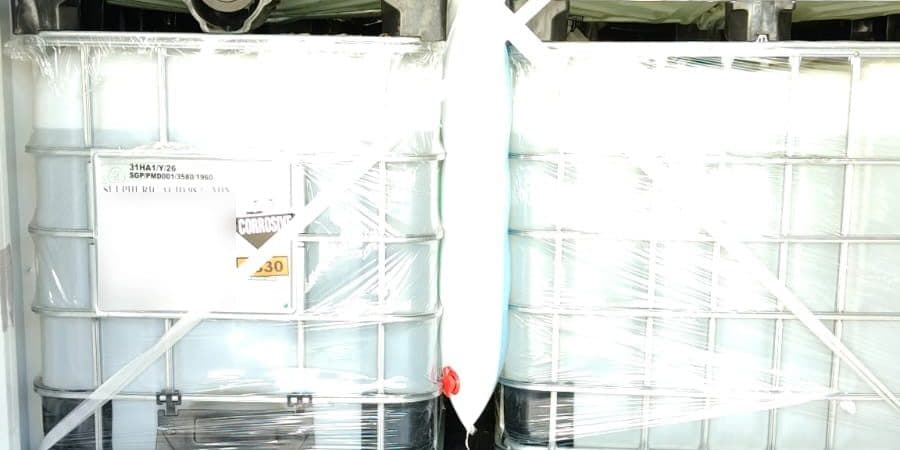
- UN-approved packaging. Liquids such as sulphuric acid are often shipped in composite IBCs marked with a UN packaging code (for example 31HA1), which shows the container is approved for liquid dangerous goods. Check that the marks match the product.
- Labels and placards — Class 8 corrosive diamonds and the UN number on every package and on the container.
- Secure stowage — IBCs stretch-wrapped, strapped and braced so they cannot shift on the voyage.
- Ports. Containers from India usually arrive at Vancouver or Prince Rupert on the west coast, or Montreal and Halifax in the east. Sea transit is typically several weeks, so plan stock accordingly.
5. Food products and fertilizers
If you also import agro products — spices, rice, pulses or dehydrated onion — you need a Safe Food for Canadians (SFC) licence from the CFIA, as well as preventive-control and traceability records. Fertilizers such as ammonium sulphate or zinc sulphate must either be registered under the Fertilizers Act or meet the conditions for an exemption, and their labels must meet CFIA requirements.
6. What to ask your supplier for
When you request a quote from an overseas chemical supplier, ask for:
- The SDS for the exact product and grade — before you order
- A COA from a recent lot, and confirmation that every lot ships with its own COA
- The HS code, UN number, hazard class and packing group
- The packaging type and its UN approval marks
- The Incoterm (FOB, CFR or CIF) and the port of loading
- Who prepares the dangerous-goods declaration and the other shipping documents
How Kant Exim supports Canadian buyers
We supply industrial, water-treatment and fertilizer chemicals from India, with:
- A certificate of analysis for every lot and the SDS with every order — available before you confirm, so your WHMIS review can start early
- HS code, UN number and hazard class on the quotation
- UN-marked packaging for dangerous goods — for example 1,650 kg composite IBCs for sulphuric acid 98% — packed and braced for container shipment
- Shipment through Mundra Port, our nearest port, with the commercial invoice, packing list, certificate of origin and dangerous-goods documents
See our sulphuric acid 98% specifications and COA results, browse our industrial chemicals, or send us your requirement with the product, quantity and destination port for a quote.
Frequently asked questions
Do imported chemicals need a French SDS in Canada?
Yes. Under WHMIS 2015, the supplier label and safety data sheet for a hazardous product used in a Canadian workplace must be available in both English and French. As the importer, you are responsible for making sure a compliant label and SDS are in place.
What do I need before importing chemicals into Canada?
A Business Number with an import–export (RM) account, registration in CBSA's CARM portal (usually with financial security for release before payment), a customs broker, and the product's SDS, so the WHMIS label and SDS can be prepared. Also check that the substance is on the Domestic Substances List and whether precursor rules apply.
Is sulfuric acid a controlled chemical in Canada?
Sulphuric (sulfuric) acid is listed as a precursor chemical in Schedule VI of the Controlled Drugs and Substances Act. Depending on the class and quantity, registration, permits or record-keeping may apply, so confirm the requirements with your customs broker before ordering.
Which documents come with a chemical shipment from India?
Typically a commercial invoice, packing list, bill of lading, certificate of origin, certificate of analysis, safety data sheet and, for hazardous products, the dangerous-goods declaration.
How are corrosive liquids like sulphuric acid shipped to Canada?
As dangerous goods under the IMDG Code — sulphuric acid is UN 1830, Class 8 — in UN-approved packaging such as composite IBCs, labelled and secured in the container. Within Canada, road and rail moves fall under the Transportation of Dangerous Goods Regulations.
- #Canada
- #chemical import
- #WHMIS 2015
- #SDS
- #CBSA
- #CARM
- #TDG
- #sulfuric acid
- #import guide